Sex-offender screening for skilled nursing facilities
Screen every prospective admission before the bed is offered, and every hire before the first shift — across all 58 US registries, from a dashboard your admissions team can use today or an API your EHR can call.
No code needed — search from your dashboard, or integrate the full API when you’re ready.
Screening built into CarePort, WellSky, ExtendedCare, Ensocare and Aidin
Your admissions team never leaves the referral. A browser extension seats an Offendersearch screening panel right in the patient header of the referral platform you already use — one click checks the sex-offender registries and shows the answer in place. No second window, no copy-paste, no IT project, and nothing changes for the platform. A BAA is signed before use.
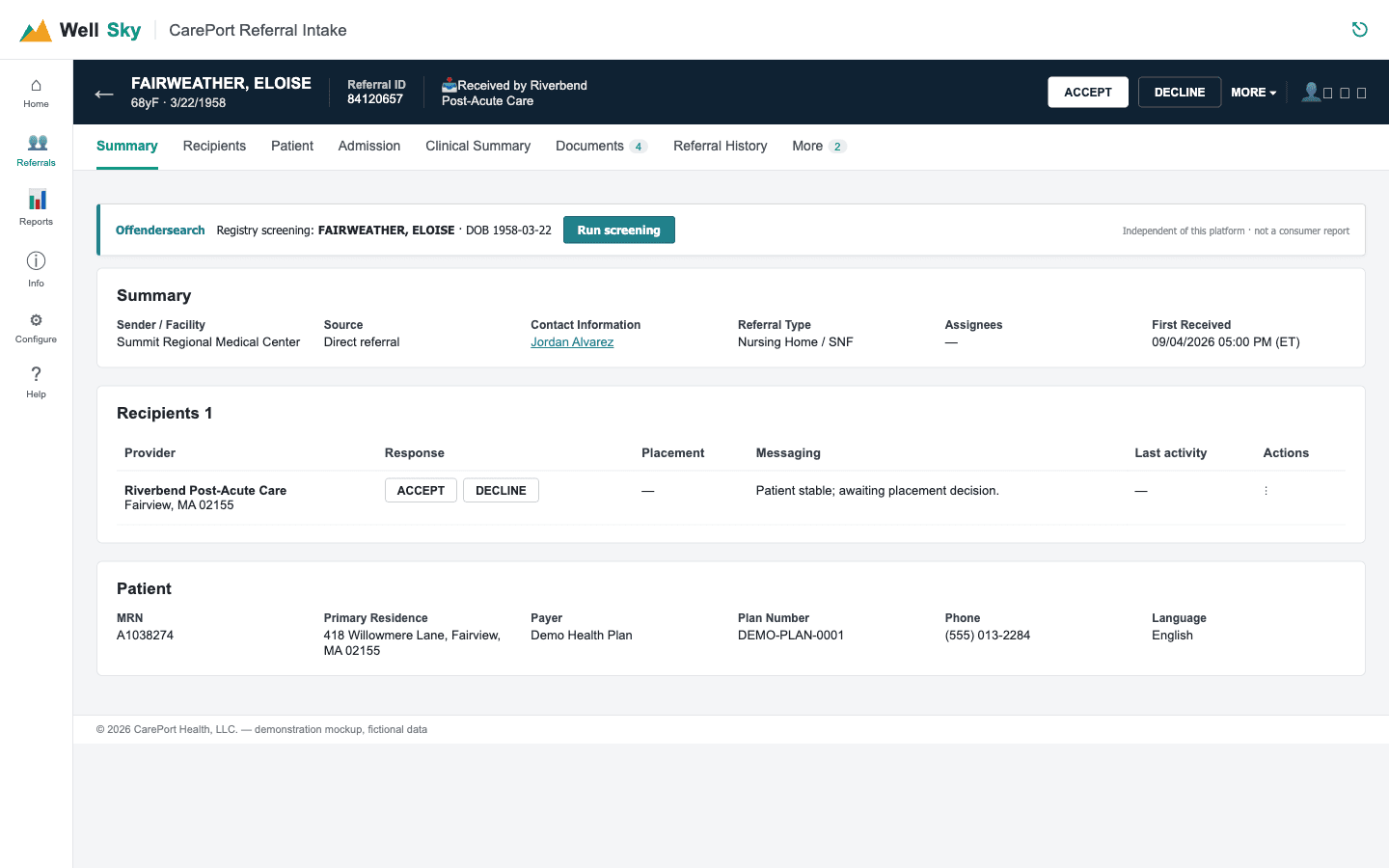
Illustration uses fictional demonstration data — no real patient.
The problem for skilled nursing facility administrators and admissions teams
- A referral can look routine until the registry says otherwise — and by then the bed is offered
- Admissions decisions move in hours; screening can’t wait on IT or a vendor portal
- Residents and staff are two different screening flows with one duty of care behind them
- Surveyors and counsel expect a record of what was checked, when, and what came back
Outcomes
- Screen every referral before a bed is offered, without waiting on IT
- Re-screen the active census and staff roster on your own cadence
- Hand a surveyor a complete, stored history of every check
How Offendersearch helps
Built into your referral workflow
A browser extension puts screening inside CarePort, WellSky, ExtendedCare, Ensocare and Aidin — the panel appears in the referral you already have open, so admissions can screen without leaving the platform. A BAA is signed before use.
Admissions screening before the bed offer
Type a referral’s name into the dashboard and get an answer in seconds — photographs, aliases, and the official registry record — before the admission packet moves any further.
Two flows, one workspace
Screen prospective residents at referral and staff at hire from the same account, with every check stored: who was searched, when, and the results you saw.
CSV for the census, API for the EHR
Upload a census or hiring list as a spreadsheet and screen everyone at once — or wire the API into your EHR and referral workflow when you’re ready.
What the law actually requires
Skilled nursing is one of the few settings where the screening duty runs in two directions at once. Federal law governs who a facility may employ. State law — in a handful of states, and only a handful — governs who a facility may admit, because the person moving into the building is moving in alongside a floor of vulnerable adults. The two bodies of rule share almost no language, run on different clocks, and are routinely confused for one another.
| Jurisdiction | Citation | Applies to | What it requires |
|---|---|---|---|
| Federal | 42 CFR § 483.12(a)(3) | Staff | A facility must not employ anyone found guilty by a court of abuse, neglect, exploitation, misappropriation of property or mistreatment; anyone carrying such a finding on the State nurse aide registry; or anyone whose professional licence has been disciplined for those findings. |
| Federal | 42 CFR § 483.12(a)(4) | Staff | A facility must report to the State nurse aide registry or licensing authority any knowledge of court action against an employee indicating unfitness for service. |
| Illinois | 210 ILCS 45/2-201.5(b) | Residents | Within 24 hours after admission, the facility must request a criminal history background check on every person aged 18 or over seeking admission. |
| Illinois | 210 ILCS 45/2-201.5(c) | Residents | If the resident is identified as a sex offender, the facility must immediately notify the Illinois State Police and, within 72 hours, arrange a fingerprint-based criminal history inquiry. |
| Illinois | 210 ILCS 45/2-201.6 | Residents | A resident who is a convicted or registered sex offender — or who the Identified Offender Report finds poses a significant risk of harm — “shall be required to have his or her own room within the facility.” |
| Virginia | 12VAC5-371-150(H) | Residents | “Prior to admission, each nursing facility shall ascertain if a potential resident is required to register with the Sex Offender and Crimes Against Minors Registry” — for any stay the facility anticipates, or that in fact runs, longer than three days. |
| Florida | Fla. Stat. § 435.04 | Staff | Level 2 screening includes a search of the sexual predator and sexual offender registries of every state in which the employee or applicant resided during the immediately preceding five years — a multi-state registry search written into the statute itself. |
Citations link to the primary text. This is background, not legal advice — obligations change, and your counsel is the right reader of your own facts.
And what it doesn’t
Worth being plain about what the federal rule does not say, because a great deal of vendor marketing implies otherwise. 42 CFR § 483.12 contains no sex offender registry search requirement at all — its employment bar turns on court findings, nurse aide registry findings and licence discipline. Nor is there any federal duty to screen a prospective resident: the resident-side obligation exists only where a state has written one, and most have not. Oklahoma is the instructive middle case — the Commissioner of Health is authorised to distribute registry information to long-term care facilities, but no statute compels the facility to run the check. Most facilities screening residents today are doing it on policy, insurer pressure or duty-of-care grounds rather than statute, and that is a perfectly sound reason. It is simply a different reason, and worth knowing which one you are relying on.
Screening practices for skilled nursing facility administrators and admissions teams
Screen the referral, not the admission
Illinois gives you 24 hours after admission; Virginia requires the check before it. Screening at referral satisfies the earlier clock and leaves room to plan a room assignment, rather than discovering the duty once the bed is filled.
Search the states a life was lived in, not just yours
A referral from an acute hospital may carry a registration from a state three moves ago. Florida’s five-year residence rule is the clearest statutory expression of a general truth: the useful search is the one that is not bounded by your own state line.
Keep the two flows separate on purpose
Resident screening and staff screening answer to different law, different timelines and different consequences. Running them through one undifferentiated “background check” is how facilities end up satisfying neither cleanly.
Record what you checked, not just what you found
A clear result is only defensible if you can show what was searched and when. Store the query, the timestamp and the per-source outcome — a registry that failed to answer is a materially different record from one that answered “no match”.
Re-screen the standing census
Registration status changes after admission. Facilities that check once at the door and never again carry a picture that is accurate only on move-in day; a periodic sweep of the active census and staff roster closes that gap.
Decide the policy before the first hit
Illinois already answers the room question by statute. Everywhere else, the time to decide how you weigh offence level, years elapsed and current clinical condition is before a match forces the decision under time pressure.
Questions from skilled nursing facility administrators and admissions teams
Can our admissions coordinator use this without any technical setup?
Yes. Sign up, type the referral’s name into the dashboard, and the answer comes back in seconds with photographs and the official registry record. The first 25 searches are free, and no payment method is needed to start.
Can we screen prospective residents as well as employees?
Yes — they’re two flows in one workspace. Screen a referral before the bed is offered, screen staff and agency clinicians before the first shift, and re-screen either group on a schedule with a CSV upload.
Does one search cover a referral coming from another state?
Yes. Every search covers all 58 US registries — every state, DC and the territories — so a registration anywhere in the country surfaces in the same search.
Is this a background check / consumer report?
No. Offendersearch is not a consumer reporting agency and results are not a consumer report; do not use them for FCRA-covered decisions without appropriate process.
Registry and criminal records on one key
Most skilled nursing facility administrators and admissions teams need more than one check, and running two vendors means two integrations, two contracts and two invoices. Both run on the same account, the same key and the same response shape.
Sex offender registry
58 US registries — the 50 states, DC and the territories — continuously updated, with photographs, aliases, addresses and the official record citation on every match.
Criminal records
more than a thousand county, state and federal jurisdictions — county jail rosters, statewide prison systems, court records and warrants — with coverage in every US state, in the same scored, source-cited schema.
1,375
county jurisdictions in the criminal roster — the layer where most US matters begin, and the one thin vendors skip.
51
states with a live statewide prison system, for the post-conviction picture in the same call.
58
US sex offender registries, continuously updated — the check skilled nursing facility administrators and admissions teams are most often required to run.
See what each state publishes, or the live list at /v1/criminal/sources.
Per check, with no floor underneath it
$0.15 a call, dropping to $0.11 for every call past 2,000 in a calendar month. No setup fee, no per-seat licence, no monthly minimum and no annual contract — so the price scales down with you as well as up.
| Checks / month | Cost | Per check |
|---|---|---|
| 500 | $75.00 | $0.1500 |
| 5,000 | $630.00 | $0.1260 |
| 50,000 | $5,580.00 | $0.1116 |
A batch is billed per row, so bulk screening costs the same per person as a single lookup. Full pricing · screen a CSV without code.
Screen skilled nursing facility administrators and admissions teams with one API
Screen every prospective admission before the bed is offered, and every hire before the first shift — across all 58 US registries, from a dashboard your admissions team can use today or an API your EHR can call.